pryanicom
Over three billion monthly active users. That’s a staggering figure, representing a significant chunk of humanity. Yet, how many marketing campaigns truly resonate with this colossal audience, rather than just shouting into the void? In 2026, Facebook isn’t merely a platform; it’s a vibrant, multifaceted ecosystem where understanding who you’re speaking to is paramount.
To navigate this immense digital ocean effectively, marketers must move beyond surface-level engagement. It’s not enough to know Facebook has users; the real power lies in comprehending the intricate tapestry of their demographics. This deep dive into age, gender, location, interests, and behaviors isn’t just an academic exercise; it’s the blueprint for precision targeting and the bedrock of any truly impactful digital marketing strategy. Imagine the difference between broadcasting to a stadium and having a direct, personalized conversation with your most valuable prospects. That’s the strategic leverage demographics provide.
Consider it your strategic compass. Grasping the nuances of Facebook’s user base allows you to tailor messages that speak directly to specific segments, optimize ad spend by reaching the most receptive eyes, and leverage platform features with surgical accuracy. This isn’t about casting a wide net; it’s about identifying your ideal audience with crystal clarity and delivering value that genuinely connects, transforming casual scrolls into meaningful interactions.
Unpacking Facebook’s Audience: A Deep Dive
To truly master marketing on Facebook, one must first understand its vast and varied user base. This isn’t just about raw numbers; it’s about dissecting the intricate layers of behavior, preference, and identity that define its billions of users. For any marketer aiming for precision and impact, a granular view of these demographics is not merely helpful—it’s absolutely essential.
Facebook remains a colossal force, boasting an impressive 2.1 billion daily active users. This immense scale is meticulously maintained, as evidenced by the platform’s proactive stance against manipulation, having removed over 3 billion fake accounts in 2024 alone. What’s particularly striking is the cross-platform engagement: a significant 77.9% of Facebook users also engage with Instagram, and 73.6% are active on both WhatsApp and YouTube, according to the 2025 DataReportal global report. This interconnectedness highlights a broader digital footprint for many users. Content consumption habits reveal that approximately 48% of users rely on the platform for news, with political leanings showing a near-even split between right (50%) and left (43%). Video content, especially Facebook Reels, commands immense attention, generating an astonishing 138.9 million plays per minute across Facebook and Instagram. Understanding Facebook demographics is fundamental for crafting effective digital marketing strategies on the platform.
Where Users Call Home
The geographic spread of Facebook’s audience offers critical insights for localized campaigns. The United States, for instance, accounts for roughly 45% of all social media site visits, cementing Facebook’s position as the most popular platform there. Its U.S. user base stood at 250 million in 2024, with projections indicating growth to 262 million by 2028. Across the Atlantic, over 81% of the UK population actively uses Facebook. Globally, India leads the pack with over 378 million users, followed by the United States (193.8 million), Indonesia (119.05 million), and Brazil (112.55 million). This concentration of users in specific regions directly translates to revenue, with 44% of Meta’s ad revenue in Q4 2024 originating from the U.S. and Canada.
Age and Engagement Patterns
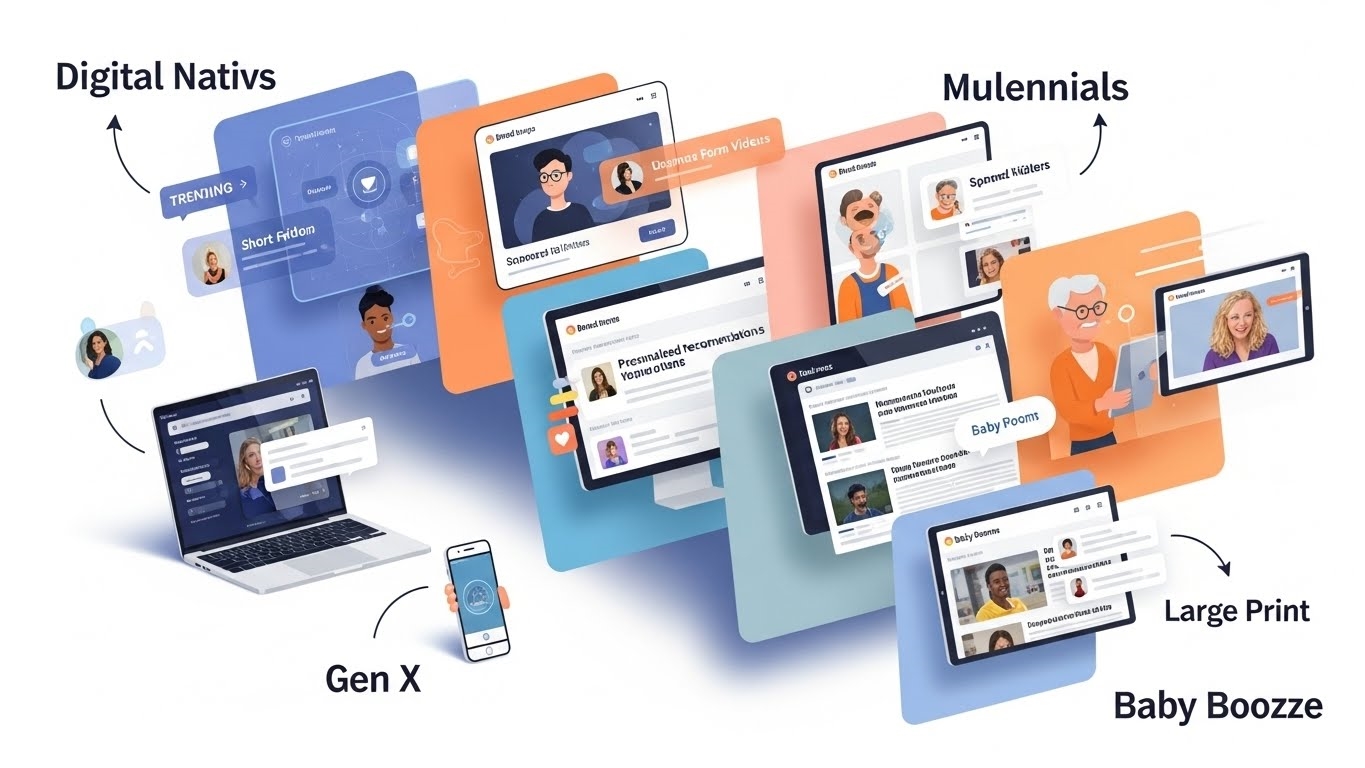
Age-based demographics reveal a platform that has matured alongside its users. The largest age group globally is 25-34 year-olds, comprising 31.1% of the total user base. This is closely followed by 18-24 year-olds at 23%, and 35-44 year-olds at 20.2%. Facebook Messenger users exhibit a similar trend, with the 25-34 age bracket forming its largest segment at 23%. While teen usage has seen a decline, with only 32% reporting use and just two in ten visiting daily, it remains notably more popular among teens from lower-income households. Interestingly, Millennials and Baby Boomers emerge as the most active weekly users, indicating sustained engagement from older demographics.
| Age Group (Global) | Percentage of Users |
|---|---|
| 25-34 years | 31.1% |
| 18-24 years | 23.0% |
| 35-44 years | 20.2% |
Gender Dynamics
A closer look at gender distribution shows that males constitute 56.8% of Facebook users, while females make up 43.2%. However, consumption patterns vary; women tend to consume more news on the platform (60%) compared to men. Digging deeper, men aged 25-34 represent Facebook’s largest audience segment globally at 18.4%, with men aged 18-24 as the second largest at 13.5%. In the U.S., the landscape shifts slightly for Messenger, where women comprise 54.6% of its user base.
Education and Income Insights
Education and income levels also paint a telling picture. College graduates are more likely to use Facebook (70%) than those with only a high school diploma (63%). For U.S. users, the largest income bracket falls between 70, 000−99,999 (74%), yet the platform also retains significant reach among lower-income groups, with 63% of adults earning $30,000 or less also active.
Device Usage and Time Spent
Facebook stands as the fourth most downloaded social mobile app globally, underscoring its mobile-first dominance. The average user dedicates an impressive 17 hours and 17 minutes to the app monthly, opening it an astounding 280.2 times per month. Regions like Egypt, the United Arab Emirates, and the Philippines demonstrate particularly high engagement in terms of both time spent and app opens, offering valuable geographical targets for specific campaigns.
Strategic Demographics: Precision Marketing on Facebook
Understanding Facebook’s vast user base isn’t merely an academic exercise; it’s the bedrock of campaigns that truly connect and convert. By dissecting demographic insights, marketers can move beyond broad strokes to craft hyper-targeted strategies that resonate deeply with specific segments. This isn’t about guesswork; it’s about data-driven precision.
Content for Every Age
The platform’s diverse age distribution demands a nuanced approach to content. For the substantial 25-54 age bracket, which includes the largest segment of 25-34 year-olds, messaging must be informative and reliable. This audience often seeks depth, value, and trustworthiness. Think detailed guides, expert interviews, case studies showcasing tangible results, or long-form video content that educates. They’re looking for solutions and credible information. Conversely, engaging younger demographics requires a different rhythm. Here, punchy, visual content reigns supreme. Short-form video, interactive polls, and highly shareable graphics designed for quick consumption are essential. This caters to their preference for immediate engagement and visual storytelling, often consumed on the go.
Localizing Campaigns with Data
Geographic data offers a powerful lever for optimizing campaign performance, whether targeting a neighborhood or an entire continent. Beyond simple language translation, true localization involves optimizing site speed through regional server deployment, implementing genuinely multilingual setups that respect cultural nuances, and ensuring payment gateways align with local preferences. Imagine a campaign in India, where local e-wallets are paramount, versus one in the US, where credit card integration is standard. Ignoring these regional specificities can introduce friction, eroding trust and conversion rates. Leveraging location-based insights transforms a generic global push into a series of highly relevant, local experiences.
Mobile-First Ad Optimization
The reality of Facebook usage is overwhelmingly mobile. With users spending an average of 17 hours and 17 minutes monthly on the app, opening it over 280 times, content must be engineered for small screens and fleeting attention spans. This means developing shorter, visually compelling content that captures interest instantly. Vertical video, concise ad copy, and clear calls to action positioned prominently are not just best practices; they are necessities. Many users access Facebook while commuting or during brief breaks, demanding content that delivers impact without requiring extensive focus. Ads that load quickly and are immediately understandable on a smartphone are non-negotiable for maximizing reach and engagement.
Industry Ad Performance Benchmarks
For marketers, understanding how different industries perform on Facebook provides critical benchmarks. The data reveals distinct patterns in engagement and efficiency:
| Industry | Click-Through Rate (CTR) | Cost Per Click (CPC) | Conversion Rate (CVR) |
|---|---|---|---|
| Legal | 1.61% | N/A | N/A |
| Retail | 1.59% | N/A | N/A |
| Apparel | N/A | $0.45 | N/A |
| Travel & Hospitality | N/A | $0.63 | N/A |
| Fitness | N/A | N/A | 14.29% |
| Education | N/A | N/A | 13.58% |
These figures are more than just numbers; they are strategic indicators. The legal and retail sectors, for instance, demonstrate robust CTRs, suggesting their content effectively captures initial interest. For apparel and travel & hospitality, the notably low CPCs present an opportunity for cost-efficient reach. Meanwhile, the fitness and education industries boast impressive conversion rates, indicating that once users engage, they are highly likely to complete a desired action.
“Precision targeting isn’t just about reaching the right people; it’s about delivering the right message, in the right format, at the right moment, tailored to their context and intent.”
By dissecting these performance metrics alongside demographic data, marketers can fine-tune their creative, optimize their bidding strategies, and allocate budgets where they will yield the most significant returns. This granular understanding transforms Facebook from a broad platform into a highly sophisticated marketing instrument.
Decoding Facebook’s Audience Blueprint
The journey through Facebook’s demographic layers reveals not just a collection of statistics, but the very pulse of its vast user base. In 2026, with over 3 billion monthly active users, navigating this platform without a granular understanding of who you’re speaking to is akin to launching a rocket without precise coordinates. It’s not merely about knowing that 25-34 year-olds form the largest segment; it’s about internalizing what that means for their media consumption habits, their purchasing power, and their preferred communication styles. This deep dive into audience composition is the indispensable bedrock for achieving genuine marketing efficacy.
Refining Strategic Approaches
This detailed demographic insight empowers marketers to refine their strategies with surgical precision. Consider the stark difference in approach when targeting the 56.8% male user base versus the 43.2% female segment, especially when data indicates women tend to consume more news on the platform. A strategy for a high-value B2B service, for instance, might leverage the 25-34 male demographic’s higher representation, tailoring ad placements to peak activity times for this group. Conversely, a direct-to-consumer brand focused on lifestyle products might find greater resonance by targeting the 54.6% female users on Messenger in the U.S., understanding their propensity for direct engagement and community building. This isn’t guesswork; it’s the precision engineering of your marketing spend, ensuring every dollar works harder.
Crafting Resonant Content
Creating relevant content transforms from a broad endeavor into an art form when informed by these insights. Knowing that 48% of users rely on the platform for news, coupled with the staggering 138.9 million plays per minute for video content, particularly Reels, dictates a strong visual, short-form video strategy for broad appeal. If your target audience skews older, perhaps towards the highly active Millennials and Baby Boomers, your content might shift to more informative, value-driven posts, potentially incorporating longer-form video or articles shared directly. For younger demographics, the punchy, trend-driven visuals are paramount. This granular understanding ensures every piece of content resonates deeply, rather than merely existing in the feed.
| Demographic Insight | Strategic Implication | Content Adaptation |
|---|---|---|
| 25-34 Age Group (31.1%) | Focus on career, family, aspirational themes | Informative, visually rich posts; short-form video |
| Mobile-First Access (17h/month) | Optimize for quick consumption, clear CTAs | Vertical video, concise text, mobile-responsive ads |
| News Consumption (48%) | Integrate current events, thought leadership | Share industry news, expert opinions, relevant articles |
| High Income (70k−99k) | Highlight value, premium features, ROI | Case studies, testimonials, aspirational imagery |
Optimizing for Peak Performance
Optimizing campaigns for maximum impact hinges directly on this demographic intelligence. When 44% of Meta’s ad revenue in Q4 2024 originated from the U.S. and Canada, it underscores the immense value of precise geographic targeting. Marketers can allocate budgets more effectively, knowing that certain regions yield higher returns and adjusting bids accordingly. Furthermore, understanding device usage – with the average user opening the app 280.2 times monthly – means campaigns must be hyper-optimized for mobile performance, featuring lightning-fast load times and thumb-stopping creative. For industries like legal and retail, boasting impressive click-through rates of 1.61% and 1.59% respectively, demographic alignment allows for fine-tuning ad placements and messaging to capitalize on these proven engagement rates, driving conversions rather than just clicks.
“Demographic data isn’t just a static report; it’s a living, breathing guide to connecting with your audience on their terms, in their preferred spaces, and with messages that genuinely matter to them.”
Ultimately, the imperative is crystal clear: ignore these demographic nuances at your peril. In 2026, the Facebook ecosystem is too vast, too dynamic, and too competitive for generic approaches. By meticulously dissecting who uses the platform, where they are, how they engage, and what drives them, marketers unlock the true potential of their campaigns. This isn’t just about reaching an audience; it’s about connecting with them, fostering loyalty, and driving measurable results that transcend mere impressions. It’s the fundamental difference between shouting into the void and sparking a genuine, impactful conversation.
FAQ
What Facebook tools aid demographic analysis?
Facebook Audience Insights provides data on user interests, behaviors, connections.
How do privacy changes affect targeting?
Stricter regulations like GDPR limit data collection, requiring marketers to rely more on first-party data.
What content types resonate most?
Interactive polls, live streams, augmented reality filters drive high engagement across diverse groups.
What are future demographic shifts?
Expect continued growth in older age groups, increasing diversity, greater global user distribution.